
Characterise and determining thermal decomposition onsets
91% Rated Excellent Turnaround
90% Rated Excellent Response to Contact
83% Rated Excellent for Report Content
Understand the hazardous nature of your materials in 3 simple steps
Obtaining and integrating ARSST data into your process has never been so easy.
Step 1: Contact Us
Step 2: Prepare & Ship
Step 3: Your Report
ARSST data you can count on
Gather ARSST data to correctly identify and mitigate process hazards without waiting months for results or having to pay tiered premiums.
Fastest UK Turnaround
Accredited QMS Data
Transparent Pricing
Post-Project Support
Get in touch to find out how Sigma-HSE
can help you prevent chemical reaction hazard incidents
Chemical reaction hazard testing solutions for every industry
Discover our range of chemical reaction hazard testing solutions
Differential Scanning Calorimetry (DSC)
Accelerating Rate Calorimetry (ARC)
Carius Tube
Reaction Calorimetry (RC)
Frequently asked questions
What is your standard methodology?
Industry standard tool for screening reactive systems, developed to compliment DIERS methodology for vent sizing.
What is the Advanced Reactive System Screening Tool (ARSST) test?
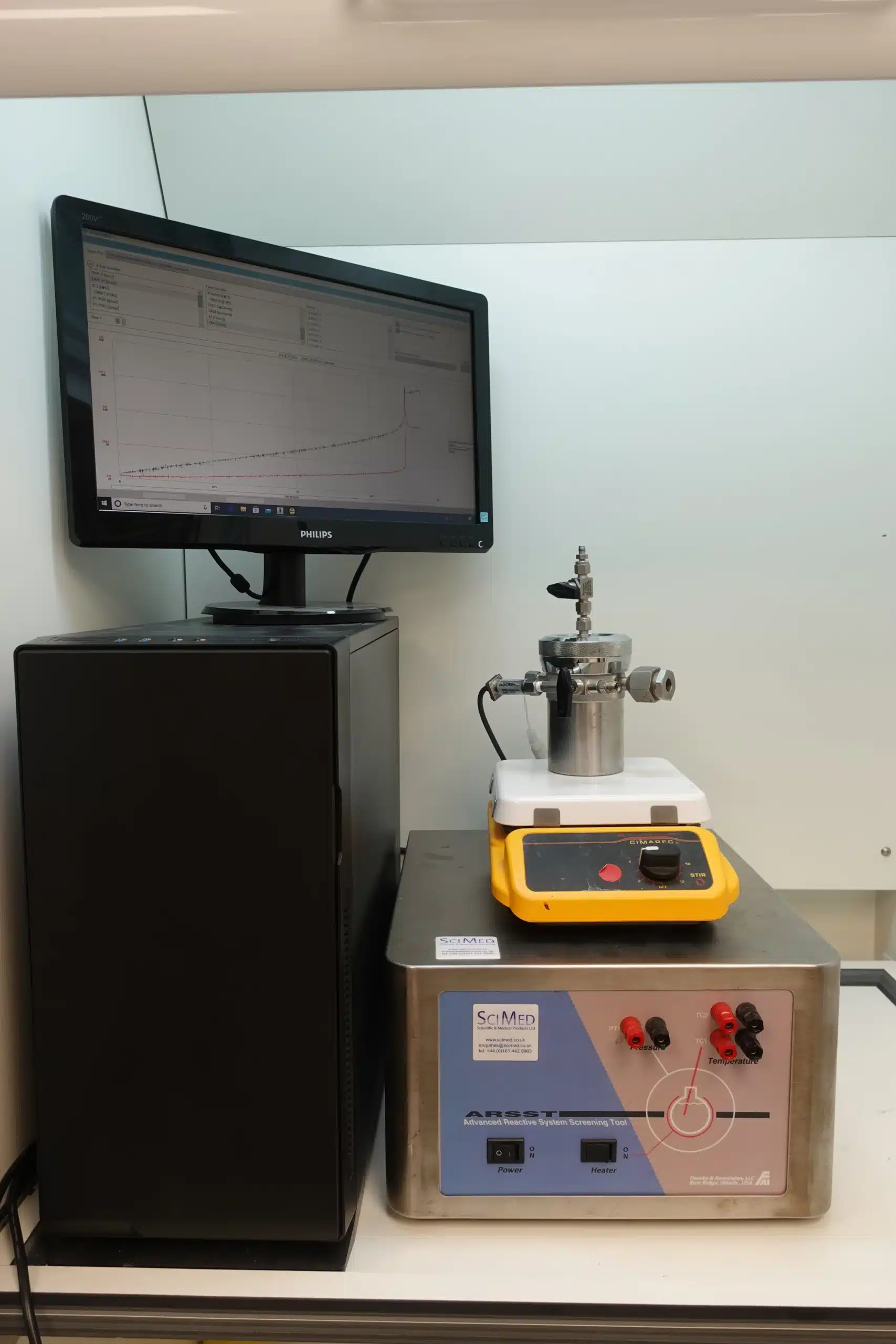
The Advanced Reactive System Screening Tool (ARSST) is an example of a pseudo-adiabatic calorimeter batch reactor tool that is used to quickly identify potential reactive chemical hazards in processes.
It consists of a well-instrumented pressure vessel that usually holds a spherical glass test cell that can heat a 10 ml sample at a specified ramp or rate, determining onset temperatures up to 400 °C. The reaction mixture, magnetic stirrer and thermocouple are introduced to this cell, while the pressure inside the vessel is measured by a pressure transducer. Due to the unique heating method by a wraparound heater, the sample is kept in a pseudo-adiabatic mode and no heat loss to the surroundings occurs.
What data can I get from the ARSST test?
Typical data outputs can include the following:
-
Rate of pressure rise
-
Heat of reaction
-
Heat of mixing
-
Total adiabatic temperature rise
-
Onset temperature
-
Tempering temperature
-
Self-accelerating decomposition temperature
-
Time to maximum rate (induction time profile)
What are the benefits of ARSST testing?
Flexible screening tool for analysis of varied Reactive Systems: basic reaction calorimetry possible with reagent mixing, thermal stability screening of mixtures and materials, and evolved pressure data to boot. Uses typically small sample sizes to compliment early-stage development.
Pseudo-adiabatic methodology for accurate determination of thermal decomposition onsets of materials, with the added benefit of pressure data collection.