
Accurately detect and identify potential reactive chemical hazards
91% Rated Excellent Turnaround
90% Rated Excellent Response to Contact
83% Rated Excellent for Report Content
Understand the hazardous nature of your materials in 3 simple steps
Obtaining and integrating ARSST data into your process has never been so easy.
Step 1: Contact Us
Step 2: Prepare & Ship
Step 3: Your Report
RC data you can count on
Gather RC data to correctly identify and mitigate process hazards without waiting months for results or having to pay tiered premiums.
Fastest UK Turnaround
Accredited QMS Data
Transparent Pricing
Post-Project Support
Get in touch to find out how Sigma-HSE
can help you prevent chemical reaction hazard incidents
Chemical reaction hazard testing solutions for every industry
Discover our range of chemical reaction hazard testing solutions
Differential Scanning Calorimetry (DSC)
Accelerating Rate Calorimetry (ARC)
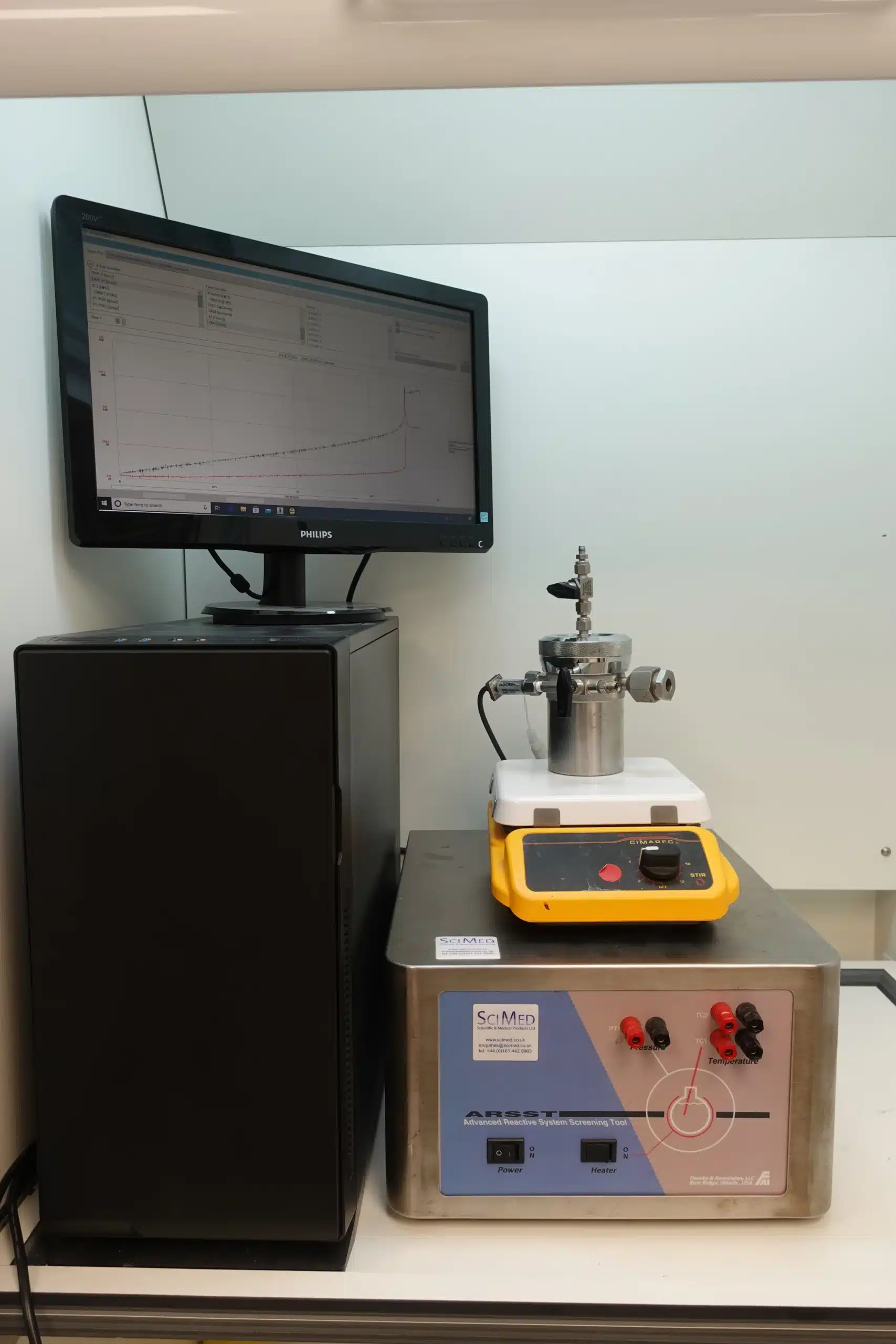
Advanced Reactive System Screening Tool (ARSST)
Carius Tube
Frequently asked questions
What is your standard methodology?
Reaction Calorimetry is an industry standard tool for assessing Chemical Reaction Hazards for process scale-up. Method bespoke to the reaction under study.
Each test involves a bespoke developed method depending on the specific requirements of the chemical reaction to be studied.
What is the Reaction Calorimetry test?
The Reaction Calorimetry test consists of a well-instrumented apparatus with adaptable peripheral measurement and processing instruments. The reaction vessel holds modest volumes of material (~300 ml) allowing for highly representative mixtures of bulk reactions, and can study the accurate heat of reactions and kinetics for reagent additions. Reactions are performed under isothermal conditions, and by use of well calibrated equipment the heats of reactions are determined.
Either Heat Flow Calorimetry or Power Compensated Calorimetry methods can be used to detect temperature rises in the reaction mixture, and the mode is selected to best suit the reaction to be studied.
At Sigma-HSE, we offer both the Heat Flow Calorimetry test and the Power Compensated Calorimetry test to your specific requirements.
What data can I get from the Reaction Calorimetry test?
The selection of different operational modes depends on material viscosities, exothermic magnitude and phase mixtures. Typical data outputs can include the following:
- Heat of reaction
- Heat of mixing/addition
- Total adiabatic temperature rise
- Gas generation quantification
- Tempering temperature
- Reaction kinetics information
What are benefits of the Reaction Calorimetry test?
Data from Reaction Calorimetry allows for accurate assessment of Chemical Reaction Hazards for a desired chemical reaction process.
The outputs allow for the adequate design of process safety systems to take your process from lab or pilot plant scale to full production; with the confidence that the process has been assessed for potential hazards.