
Why Are Early-Stage Design Decisions Critical for Process Safety?
Date Published:
Reviewed by:
Dr Oliver Armstrong
TL;DR
Early design-stage choices in chemical processes are critical because they determine whether hazards are identified, controlled, and safely scaled up, or whether hidden thermal, reactive, or explosive risks remain unnoticed and evolve into process failures during pilot or production operation.
Should you consider a chemical process evaluation strategy?
If you answered “no” to any of the following questions, you may want to consider creating a chemical process evaluation testing strategy:
Do you have a clear understanding of the thermal and reactive hazards in your process before scale-up begins?
Do you have evidence that dusts, vapours, or gases in your process won’t form explosive atmospheres under abnormal conditions? Is this evidence documented in your process safety management strategy?
Do you have data confirming that your cooling, mixing, and dosing systems can handle worst-case scenarios?
Do you have verified information on decomposition behaviour, gas generation, and runaway potential for all reagents and intermediates?
Do you have the required DSEAR or ATEX testing data to demonstrate that your design is safe, compliant, and engineered for credible failure modes?
Early-stage design choices in chemical processes often determine whether a system will operate safely, or drift toward potential failure. At this stage, chemists and engineers select reaction routes, evaluate materials, and begin considering scale-up from the laboratory to pilot and production environments.
What is often overlooked is that these same decisions can also create the conditions where process failure can begin.
Process failure occurs when a system slips outside its intended operating window and can no longer be safely controlled. In the lab, this risk feels remote as small batches shed heat quickly, glassware can vent pressure, and human intervention is easy.
But scale changes everything. In an industrial reactor, heat can accumulate faster than it can be removed, pressure can rise abruptly, and small deviations can escalate into uncontrolled events.
Both reactive systems (where runaway reactions or decompositions may release uncontrolled energy) and non-reactive systems (where dusts, vapours, or gases can form explosive atmospheres) carry serious hazard potential.
Recognising these hazards early and embedding safeguards into your process design from the start is responsible engineering.
What Does Process Failure Mean in Chemical Process Design?
Process failure often occurs when energy release exceeds system capacity, driving runaway reactions, pressure surges, or explosions.
Reactive systems can exhibit uncontrolled energy release from exothermic reactions, thermal decomposition, or runaway behaviour. Common examples include nitrations, oxidations, polymerisations and reactions that may run smoothly under controlled conditions but escalate to crisis if cooling capacity is lost, dosing is mismanaged, or impurities alter the pathway.
Process Safety Insight
Industry analyses emphasises that inadequate understanding of thermal hazards during scale-up is a significant contributor to runaway incidents
In fact, HSE guidance emphasises that scale-up to pilot plant is the critical stage for revealing thermal hazards that bench work can mask. This is when a thermal behaviour assessment (including calorimetry) becomes essential to identify runaway potential.
Non-reactive systems are equally as dangerous. Powders such as flour, sugar, or wood dust, which can be safe in bulk, may explode when dispersed in air. Solvent vapours or intermediates accumulating in poorly ventilated spaces may ignite with a spark. Even static electricity, if not controlled, can initiate combustion.
In both cases, the mechanism of failure is the same: energy is released faster than the system can absorb or control it. As a result, safeguards will fail either because they were not designed for credible scenarios, or because the hazards were never identified.
Workplace Example
The 2008 Imperial Sugar refinery explosion illustrates how “inert” materials can fuel catastrophic secondary blasts when design fails to address accumulation and dispersion.
In both cases, the mechanism of failure is the same: energy is released faster than the system can absorb or control it. As a result, safeguards will fail either because they were not designed for credible scenarios, or because the hazards were never identified.
How Do Runaway Reactions Escalate in Reactive Systems?
Most runaway reactions begin when cooling capacity is exceeded, and the Maximum Temperature of the Synthesis Reaction (MTSR) surpasses decomposition limits.
When this happens, a secondary exothermic decomposition can begin. These secondary decompositions are often more energetic than the intended synthesis. Gases are then produced which, in turn, leads to rapid increases in both temperature and pressure.
According to the CSB, approximately 60% of reactive system accidents are linked to poor or absent thermal hazard assessment. Too often, calorimetry is not performed at the design stage, leaving critical gaps in understanding runaway potential. Again, DSEAR and ATEX explicitly require thermal hazard assessments before scale-up.
Workplace Example
A nitration process appeared stable in lab glassware. When scaled up, insufficient cooling caused acceleration and gas evolution that forced emergency venting. No injuries occurred, but production was halted for months. The failure in this particular process was traced back to missing calorimetry data.
Why Must Engineers Analyse Both Normal and Abnormal Operations?
A process cannot be considered safe if it has only been evaluated under ideal conditions. Instead, chemical engineers must analyse normal operation and any potentially credible misoperations.
Reactive Systems
For reactive systems, hazard evaluation must extend well beyond measuring the intended heat of synthesis. Processes need to be stress-tested against abnormal conditions that can occur during real-world operation:
- Loss of Cooling Capacity: If cooling is reduced or lost altogether, reaction heat may accumulate faster than it can be removed. This can push the system toward self-heating, where temperature rises uncontrollably and initiates runaway.
- Accelerated or Uncontrolled Dosing: Overfeeding a reactant, whether due to pump malfunction or operator error, can overwhelm the reaction’s thermal balance. Instead of steady heat release, the system can tip into rapid acceleration, raising the Maximum Temperature of the Synthesis Reaction (MTSR).
- Agitation Failure: Mixing is often assumed to be constant, but loss of agitation creates stagnant zones. In exothermic reactions, these localised regions can overheat, leading to decomposition or hot-spot-driven runaway.
- Thermal Stability of Reagents, Intermediates, and Products: Testing must also identify the decomposition onset of all materials involved, not just the target product. Unstable intermediates or impurities can decompose at lower temperatures, producing secondary exotherms and potentially large volumes of gas. Without this insight, relief systems may be severely under-designed.
Non-Reactive Systems
Non-reactive systems demand equal scrutiny. Engineers, during the design phase, must evaluate:
- How easily the material disperses,
- Whether credible ignition sources exist nearby, and
- How much dust could be mobilised during maintenance, cleaning, or equipment upset.
A material that appears stable in bulk may present fire and explosion risks once conditions deviate.
We'll guide your Process Safety
Testing Strategy
Our consultancy team are on hand to discuss your requirements and provide actionable safety solutions.
Contact UsWhat Testing Do Regulations Like DSEAR, ATEX, and OSHA Require?
Regulatory frameworks require data to prove your safety case.
- DSEAR: obliges identification and control of risks from flammable vapours, gases, combustible dusts and dangerous substances. Dust explosibility testing and ignition energy assessments are required to demonstrate compliance.
- ATEX: applies to processes and equipment in potentially explosive atmospheres. Compliance requires ignition sensitivity data, vapour profiles, and documented control strategies.
- OSHA PSM: expects hazard analysis and testing data for highly hazardous chemicals to underpin safe operating procedures.
- UN Transport Regulations: require calorimetric data to classify reactive or unstable substances during shipment.
Across all jurisdictions, the principle remains the same, you must provide evidence for both safe design and regulatory approval.
What Testing Does Sigma-HSE Provide for Safe Process Design?
Testing is the most reliable way to replace assumptions with actionable data in chemical process design. Without it, engineers are forced to extrapolate from small-scale observations or literature values, which can mask hidden hazards and create unsafe designs. We’ve listed a few of our testing methods and how they can help below.
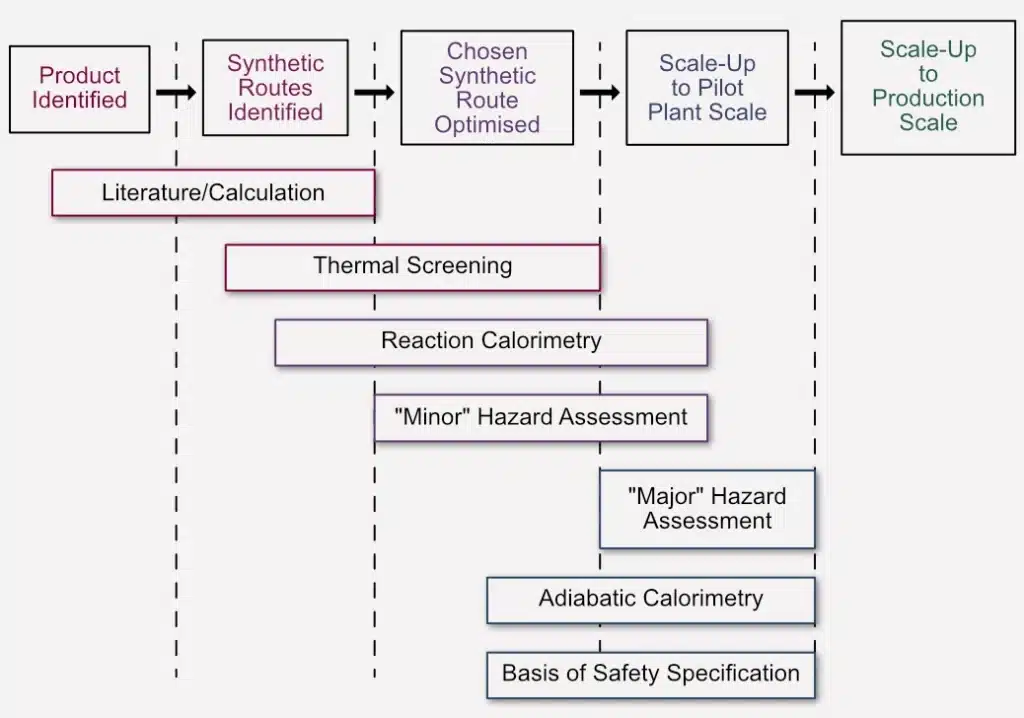
Thermal Screening
Thermal screening is often the first step in evaluating a new chemical process. By heating reagents, intermediates, and products under controlled conditions, we can detect low-temperature decomposition events, unstable exotherms, or unexpected reactions that could pose serious hazards at scale.
Early identification of these risks allows unsuitable synthetic routes to be eliminated before significant investment in equipment, materials, or pilot studies.
Reaction Calorimetry
Once a reaction route is selected, reaction calorimetry provides quantitative data for scale-up. This technique allows us to measure the rate and magnitude of heat release under actual process conditions, allowing us to calculate adiabatic temperature rise, identify peak heat generation, and determine safe cooling requirements.
The insights gained include the sizing of cooling systems, the design of dosing strategies, and reactor configuration. Test data can be used to ensure that energy generated by the reaction can be safely managed.
Adiabatic Calorimetry
Adiabatic calorimetry goes a step further by simulating worst-case scenarios, such as cooling failure, dosing surges, or agitation loss. These tests reveal whether a system can self-heat to decomposition, whether gases are generated during runaway reactions, and whether relief systems are adequate to prevent overpressure.
Many historical runaway reactions could have been prevented if adiabatic testing had been performed during the design stage. This data is crucial for engineering safe processes and demonstrating due diligence under regulatory frameworks.
Together, the above tests can provide a comprehensive understanding of how your process behaves under both normal and abnormal conditions.
What Are the Most Common Sources of Failure in Process Design?
Process failures rarely happen by chance. In most cases, they can be traced back to assumptions, oversights, or gaps in knowledge made at the very start of process design. By the time a design reaches pilot or production scale, those early decisions may already have created the conditions for failure.
- Scale-Up Assumptions: Lab behaviour is often assumed to translate directly to pilot scale. But heat dissipation, mixing, and manual oversight differ radically.
- Over-Reliance on Normal Operation: Cooling, venting, and dosing are often sized for intended synthesis, not deviations. In one nitration case, adequate cooling for the primary exotherm failed instantly when decomposition began.
- Equipment Reliability: Designs assume agitators, pumps, and cooling systems will not fail. Fouling and breakdowns occur. A stalled agitator in an exothermic system can create hot spots that trigger runaway.
- Human Factors: Many failures arise from operator missteps such as wrong valve sequence, bypassed alarms, or dosing errors. Design must tolerate human error through clear instrumentation, interlocks, and relief sizing.
- Incomplete Hazard Data: Without calorimetry, explosibility tests, or electrostatic hazard characterisation, risks remain invisible. Literature values and “similar compound” data are insufficient, and small variations can drastically alter hazard behaviour.
How Can Engineers Build Resilient and Robust Chemical Process Designs?
Process safety and responsible engineering is built in the design phase. The earliest choices in reaction route, scale-up strategy and data collection set the limits of what a process can withstand under stress.
Most failures trace back to assumptions made during this stage. These failures are usually related to scaling laboratory behaviour directly, designing only for normal operation, or relying on incomplete hazard data.
By replacing assumptions with testing, anticipating both normal and abnormal scenarios, and embedding safeguards into every phase of operation, engineers can design systems that are resilient rather than fragile.
Early-stage design decisions determine whether processes run smoothly or escalate toward failure. Early awareness, rigorous testing, and conscious design are the engineer’s strongest defences against accidents that are otherwise preventable.
On-Demand: Using Data to Avoid Catastrophic Failure of Your Chemical Process
Learn more about process safety testing in our FREE on-demand webinar.
Table of Contents
We'll guide your
Process Safety Strategy
Free Technical Consultation
Cross-Functional Support
Global PSM Support
Frequently asked questions
When should I start thermal hazard testing during process development?
Thermal screening and reaction calorimetry should begin as soon as a reaction route is selected. Early testing prevents unsafe pathways from progressing into pilot or plant scale, where hazards become harder and more expensive to manage.
How do I know if my reaction needs calorimetry?
If your process involves exothermic chemistry, new reagents, uncertain impurity profiles, or any step where cooling or dosing is critical, calorimetry is essential. Even “routine” reactions can behave unpredictably at scale.
What if I only need to confirm compliance for DSEAR or ATEX?
Your process still requires testing to demonstrate ignition sensitivity, vapour profiles, dust explosibility, and reactive chemical stability. Our testing provides the data needed for safe zoning, equipment selection, and documentation.
What testing services can Sigma-HSE provide to support safe design?
We offer thermal screening, reaction calorimetry, adiabatic calorimetry, dust and vapour explosibility testing, electrostatic hazard analysis, and regulatory-compliance data packages to support safe, resilient process scale-up from lab to production.