Chemical Process Evaluation

Detect hazardous reactions and optimise your process design
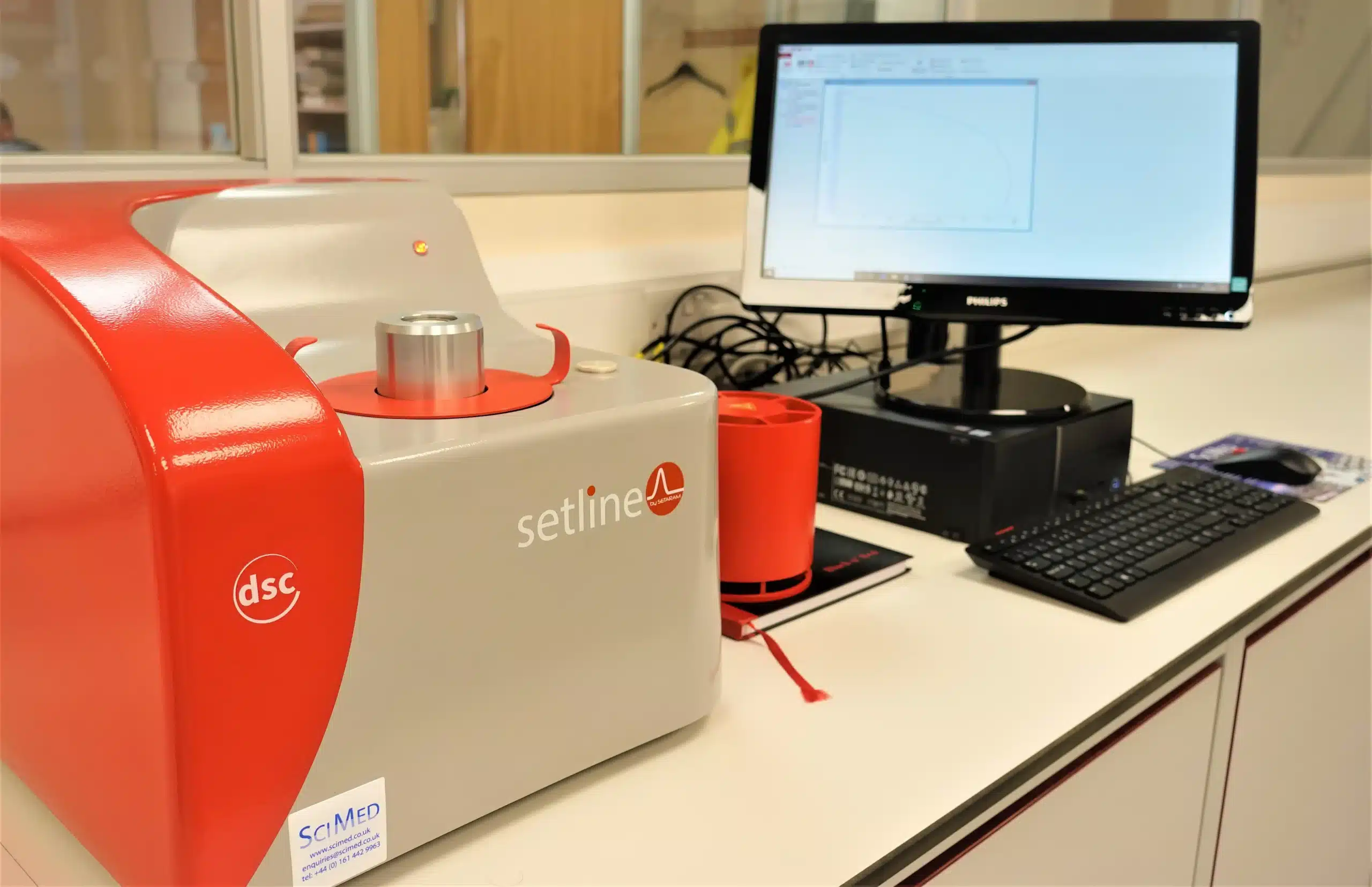
Our UK laboratory generates thermal screening and Differential Scanning Calorimetry (DSC) test data for your hazardous materials and chemical reactions. 
ukas-iso-17025

91% Rated Excellent Turnaround

90% Rated Excellent Response to Contact

83% Rated Excellent for Report Content

CONTACT US

Understand the hazardous nature of your materials in 3 simple steps

Obtaining and integrating DSC data into your process has never been so easy.

Step 1: Contact Us

Fill out the form today and one of our experts will reach out within 24 hours to learn more about your project.

Step 2: Prepare & Ship

We'll tell you what samples we need, the quantities we require, and how to prepare and ship to our UK laboratory.

Step 3: Your Report

Once we've received your samples, we'll begin testing. You will get your report within 10 working days.
Our DSC can provide the below valuable outputs to ISO 17025 Accreditation ASTM E537-24:
Constant Ramp Thermal Stability (25 – 500 °C)
Endothermic/Exothermic enthalpy and temperature onset determination
Our DSC can also provide the below:
Explosive/peroxides/self-reactive substances Screening as per UN Manual of Tests and Criteria
Isothermal Testing - SADT Estimation/Thermal Stress Testing
Physiochemical Studies - Boiling Point/Melting Point/Specific Heat Capacity /Purity
Polymer studies – Degree of Curing/Crystallinity/Glass Transition
~10 mg required for a single test, high pressure crucibles (up to 500 bar), samples can be prepared and sealed under different headspaces.

DSC data you can count on

Gather DSC data to correctly identify and mitigate process hazards without waiting months for results or having to pay tiered premiums.

Fastest UK Turnaround

Keep your process projects on track and the regulators off your back with a quote delivered to you in days. Following receipt of your sample you'll have your actionable report within 3 weeks, so you keep projects on schedule and avoid costly downtime.

Accredited QMS Data

Rest assured knowing that the data you receive is accurate, reproducible and legally defensible. Your Differential Scanning Calorimetry data will be tested under our ISO 17025 accredited Quality Management System.

Transparent Pricing

We take the time to understand your process and will only recommend the tests you need. Tailored and effective testing proposals help you save time and reduce financial pressure.

Post-Project Support

Our support doesn't end when the test results are delivered. We provide ongoing interpretation, guidance, and application of your data, helping you integrate insights into safe, effective process decisions

Get in touch to find out how Sigma-HSE
can help you prevent chemical reaction hazard incidents
Our dedicated team of experts is committed to helping ensure that your process operations will not generate fires, explosions or thermal runaway events so you can maintain a safer working environment and comply with the regulatory standards.
Contact us today for a Free DSC Quote
Fill out the form below and we’ll be back in touch within 24 hours.

Sigma-HSE needs the contact information you provide to us to contact you about our products and services. You may unsubscribe from these communications at any time. By continuing, you agree to Sigma-HSE’s Terms & Conditions and Privacy Policy.

chemical-reaction-hazards

Chemical reaction hazard testing solutions for every industry

Our chemical process evaluation expertise and knowledge spans multiple industries and our solutions can be applied to your specific chemical processing operations.
Aerospace
Pharmaceuticals
Agrochemicals & Pesticides
Life Sciences
Chemical Manufacturing
Contract Manufacturers
Transportation & Logistics
Paints & Solvents
Fine Chemicals
Research & Development

Discover our range of chemical reaction hazard testing solutions

We also undertake the following thermal screening and calorimetry tests to simulate full scale process, and process upset conditions. ​

Accelerating Rate Calorimetry (ARC)

ASTM E 1981-22
ISO/IEC:17025 Accredited
Test conducted to assess the time, temperature and pressure data of a material as it undergoes a physicochemical change under near adiabatic conditions.
Order Test >

Carius Tube

Recognised industry standard test
It is primarily undertaken to investigate exothermic activity and gas generation. It can aid in the detection of exothermic activities such as onset temperatures and identify the pressure effects of gas generation.
Order Test >

Reaction Calorimetry (RC)

Bespoke to reaction under study
Testing method is used to identify potential reactive chemical hazards in processes. Each test involves a bespoke developed method depending on the specific requirements of the chemical reaction to be studied.
Order Test >

Advanced Reactive System Screening Tool (ARSST)

Recognised industry standard test
Test is a pseudo-adiabatic calorimeter batch reactor tool that is used to quickly identify potential reactive chemical hazards in processes including the determination of thermal decomposition onsets.
Order Test >

Frequently asked questions

ASTM E 537-12

The Differential Scanning Calorimeter (DSC) is a widely used thermal analysis instrument and is conducted as a screening method to assess the extent and presence of enthalpic changes and to approximate both the onset temperatures and decomposition enthalpies (heats) (heats) of solids, liquids or slurries. Very small sample sizes of 5-10 mg are used, complimenting lab-stage process developments for hazard assessment.

Qualitative information regarding material vaporisation and melting onsets also help to assess reaction hazards over a large temperature range.

The DSC test can detect potentially hazardous reactions from volatile chemicals while estimating the probability of a hazard and the time at which a hazardous reaction may occur.

This test is conducted by inserting the desired material and a thermally inert reference material into isolated crucibles within the instrument. Both the testing sample and the reference material are then simultaneously heated at a controlled rate of 2 °C/min to 20 °C/min under an equilibrated atmosphere.

As the furnace temperature ramps up at the desired rate, the temperature difference between the sample and reference are recorded as heat flow (Δq) and is associated with changes in enthalpy of the sample.

Thermal transitions in state (solid-liquid, liquid-vapour, glass transitions) typically come with an endothermic heat flow as the sample takes on energy to achieve a higher energy state, whereas thermal decompositions typically involve chemical bond breaking and heat release as exothermic energy. These exothermic events pose a key hazard in processes.

Characteristics such as Specific Heat Capacity can also be elucidated from DSC analysis.

Analysis of the data is performed to indicate possible hazardous events in the context of your processes.

The DSC test can detect potentially hazardous reactions from volatile chemicals while estimating the severity of a hazard and the conditions in which a hazardous reaction may occur. The DSC can also be used as an early-stage test for detecting the potentially thermally hazardous nature of uncharacterised materials.

The DSC test is often run as a screening test complimentary to Carius Tube test, as it provides the valuable Heat of reaction data calculated from temperature and heat flow not available from the Carius Tube.

Test your materials

Getting your hazardous materials tested is an important step to prevent fires, explosions and other process-related hazards. Get in touch to learn more about how we can assist you in keeping your process plant and unit operations safe from the risks of thermal runaway.
CONTACT US
sigma-hse-logo
Are you visiting Sigma-HSE from outside your region? Visit your regional site for more relevant process safety solutions.
North & South America
UK, Europe & Rest of World