
Detect hazardous reactions and optimise your process design

91% Rated Excellent Turnaround
90% Rated Excellent Response to Contact
83% Rated Excellent for Report Content
Understand the hazardous nature of your materials in 3 simple steps
Obtaining and integrating DSC data into your process has never been so easy.
Step 1: Contact Us
Step 2: Prepare & Ship
Step 3: Your Report
DSC data you can count on
Gather DSC data to correctly identify and mitigate process hazards without waiting months for results or having to pay tiered premiums.
Fastest UK Turnaround
Accredited QMS Data
Transparent Pricing
Post-Project Support
Get in touch to find out how Sigma-HSE
can help you prevent chemical reaction hazard incidents
Chemical reaction hazard testing solutions for every industry
Discover our range of chemical reaction hazard testing solutions
Accelerating Rate Calorimetry (ARC)
Carius Tube
Reaction Calorimetry (RC)
Advanced Reactive System Screening Tool (ARSST)
Frequently asked questions
What is your standard methodology?
ASTM E 537-12
What is the Differential Scanning Calorimetry test?
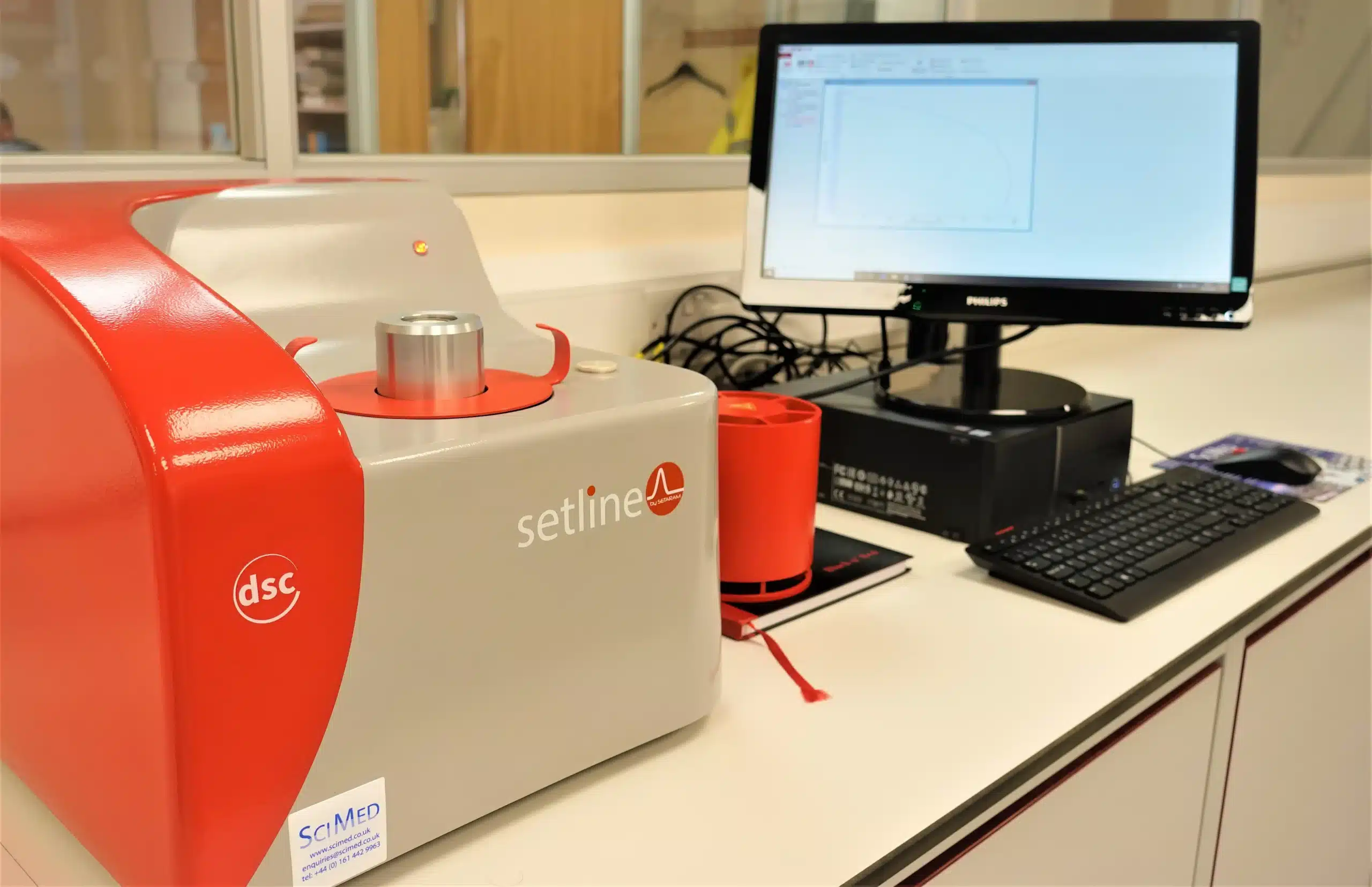
The Differential Scanning Calorimeter (DSC) is a widely used thermal analysis instrument and is conducted as a screening method to assess the extent and presence of enthalpic changes and to approximate both the onset temperatures and decomposition enthalpies (heats) (heats) of solids, liquids or slurries. Very small sample sizes of 5-10 mg are used, complimenting lab-stage process developments for hazard assessment.
Qualitative information regarding material vaporisation and melting onsets also help to assess reaction hazards over a large temperature range.
The DSC test can detect potentially hazardous reactions from volatile chemicals while estimating the probability of a hazard and the time at which a hazardous reaction may occur.
How does the Differential Scanning Calorimetry test work?
This test is conducted by inserting the desired material and a thermally inert reference material into isolated crucibles within the instrument. Both the testing sample and the reference material are then simultaneously heated at a controlled rate of 2 °C/min to 20 °C/min under an equilibrated atmosphere.
As the furnace temperature ramps up at the desired rate, the temperature difference between the sample and reference are recorded as heat flow (Δq) and is associated with changes in enthalpy of the sample.
What data can I get from the Differential Scanning Calorimetry test?
Thermal transitions in state (solid-liquid, liquid-vapour, glass transitions) typically come with an endothermic heat flow as the sample takes on energy to achieve a higher energy state, whereas thermal decompositions typically involve chemical bond breaking and heat release as exothermic energy. These exothermic events pose a key hazard in processes.
Characteristics such as Specific Heat Capacity can also be elucidated from DSC analysis.
Analysis of the data is performed to indicate possible hazardous events in the context of your processes.
What are benefits of the Differential Scanning Calorimetry test?
The DSC test can detect potentially hazardous reactions from volatile chemicals while estimating the severity of a hazard and the conditions in which a hazardous reaction may occur. The DSC can also be used as an early-stage test for detecting the potentially thermally hazardous nature of uncharacterised materials.
The DSC test is often run as a screening test complimentary to Carius Tube test, as it provides the valuable Heat of reaction data calculated from temperature and heat flow not available from the Carius Tube.